
The Significance of Havan: Sacred Fire Rituals at Home
Long before there were temples or murtis, there was fire. In the Rig Veda — the oldest Hindu scripture, composed over three thousand years ago — Agni (fire) is invoked in the very first verse. Every offering made into the sacred flame, the rishis taught, is carried directly to the gods. This is the ritual of havan (also called yagna or homa), and it can still be performed at home, simply and safely, today.
What havan actually does
On the practical level, a havan is a controlled fire into which you offer dried herbs, ghee, and grains while chanting Vedic mantras. On the spiritual level, it represents three things at once:
- Purification — the smoke from authentic havan samagri is rich in essential oils that cleanse the air. Modern studies have shown that havan smoke reduces airborne bacteria significantly.
- Offering — every "Swaha" at the end of a mantra is the moment the offering is given to the fire. It's a practice of letting go.
- Communion — fire is the only one of the five elements you cannot grasp without being burned. The havan teaches respect through proximity.
What goes into authentic havan samagri
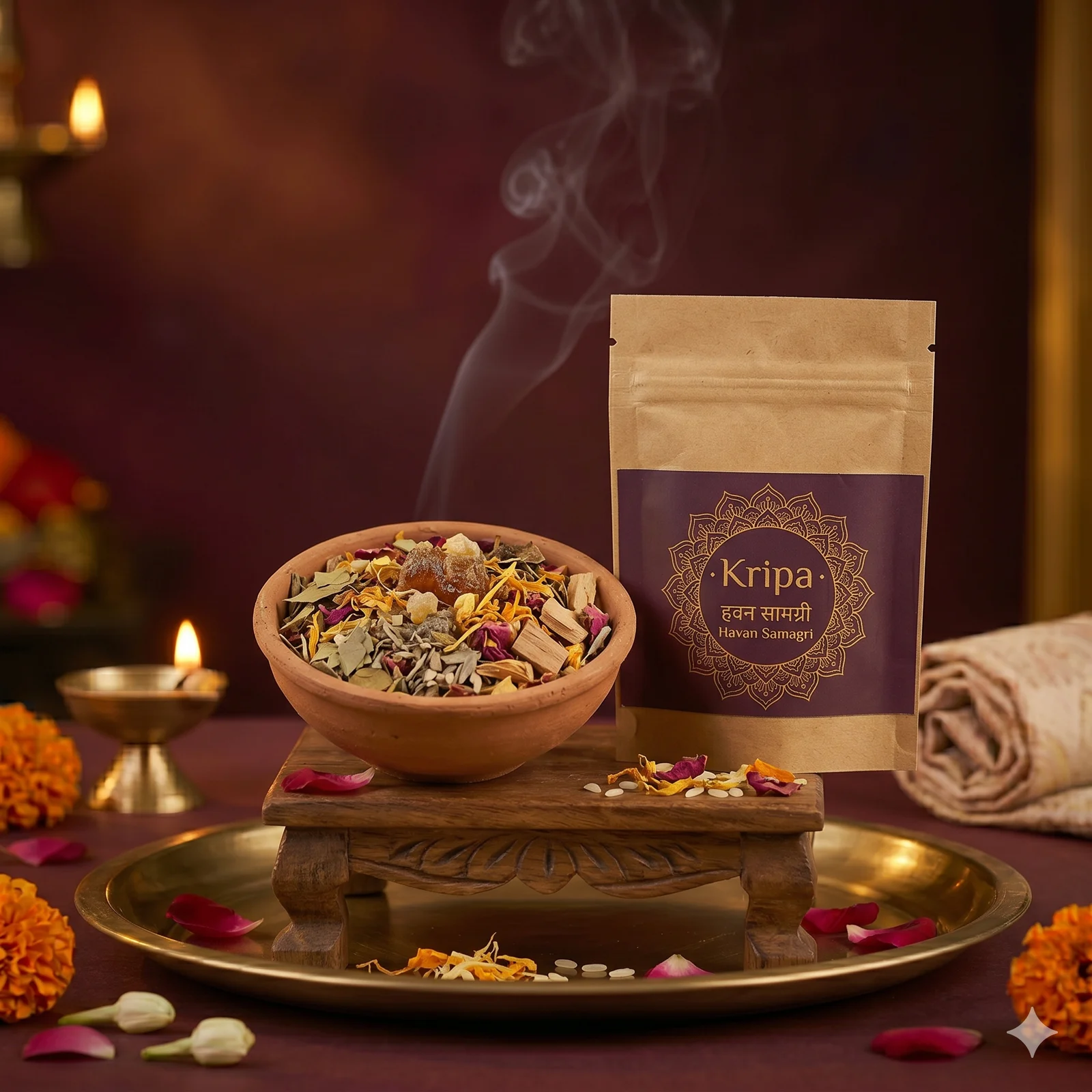
Real samagri is not a single herb — it's a precise blend of dried roots, woods, leaves, seeds, and resins that produces a clean, fragrant smoke. A traditional mix includes:
- Sandalwood powder (chandan) — the base, slow-burning and fragrant.
- Dried tulsi leaves — sacred to Vishnu and antimicrobial.
- Guggal (Indian myrrh resin) — clears stagnant air.
- Dried jasmine, rose petals — for fragrance.
- Camphor (kapur) — to ignite the offering and lift the smoke.
- Wheat, barley, sesame seeds — the grain offering.
- Loban, agar, kasturi — for depth and longevity of the smoke.
Hand-blended sacred herb mix — sandalwood chips, guggul resin, dried flowers, and 21 sacred ingredients for the yagna fire.
The two essentials beyond samagri
Pure cow ghee
Every offering of samagri is preceded by a small spoonful of ghee dropped into the fire. Ghee is what makes the fire sing — it flares briefly, lifts the smoke, and adds the sattvic quality the ritual is built around. A2 cow ghee is the traditional choice.
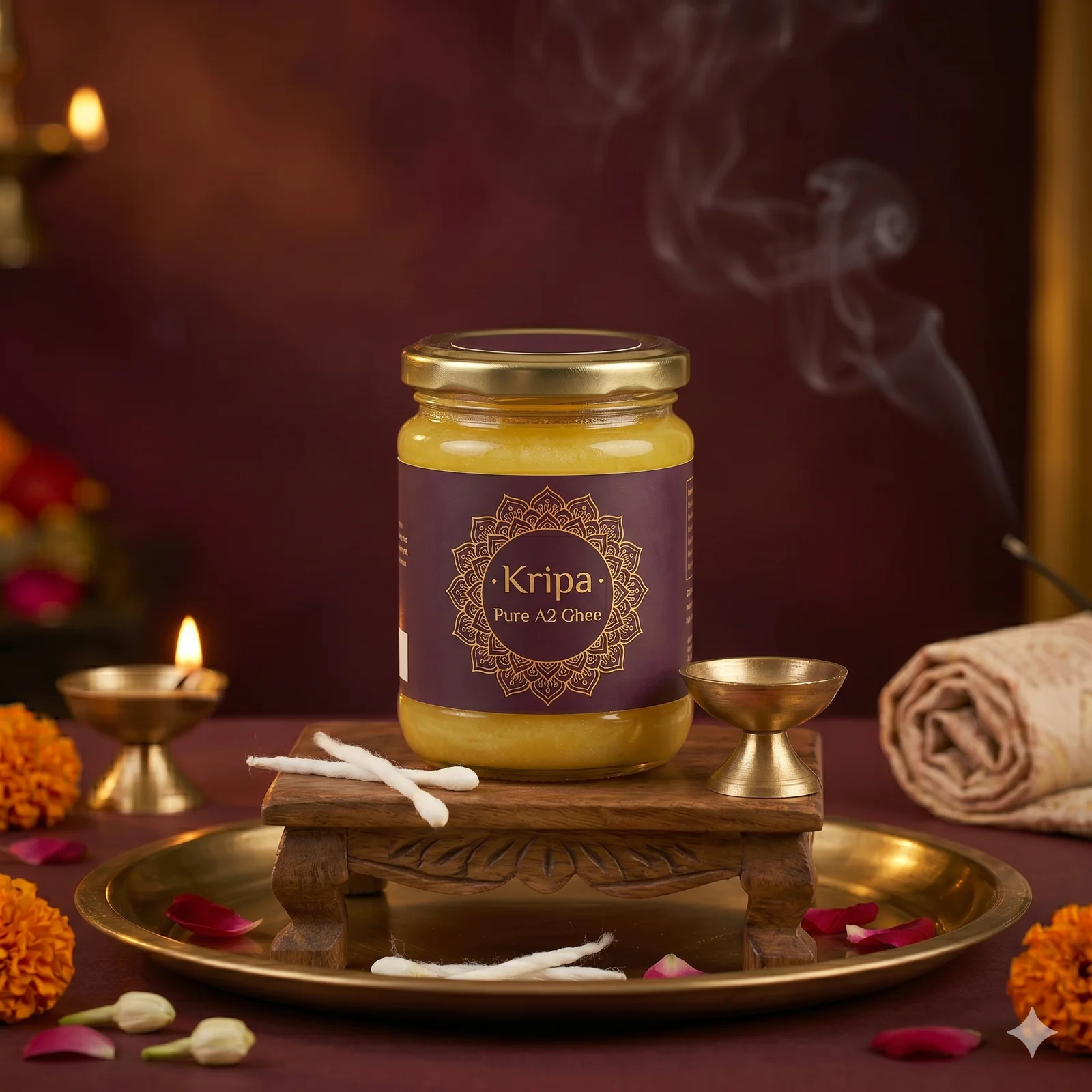
Bilona-churned A2 cow ghee — the pure ghee for diya, abhishekam, and Ayurvedic anointing. Liquid gold from indigenous breeds.
Camphor (kapur)
A single tablet of camphor placed at the centre of the havan kund is the easiest, safest way to ignite the fire. It burns clean, leaves no residue, and produces the characteristic blue flame that the rishis associated with purification.
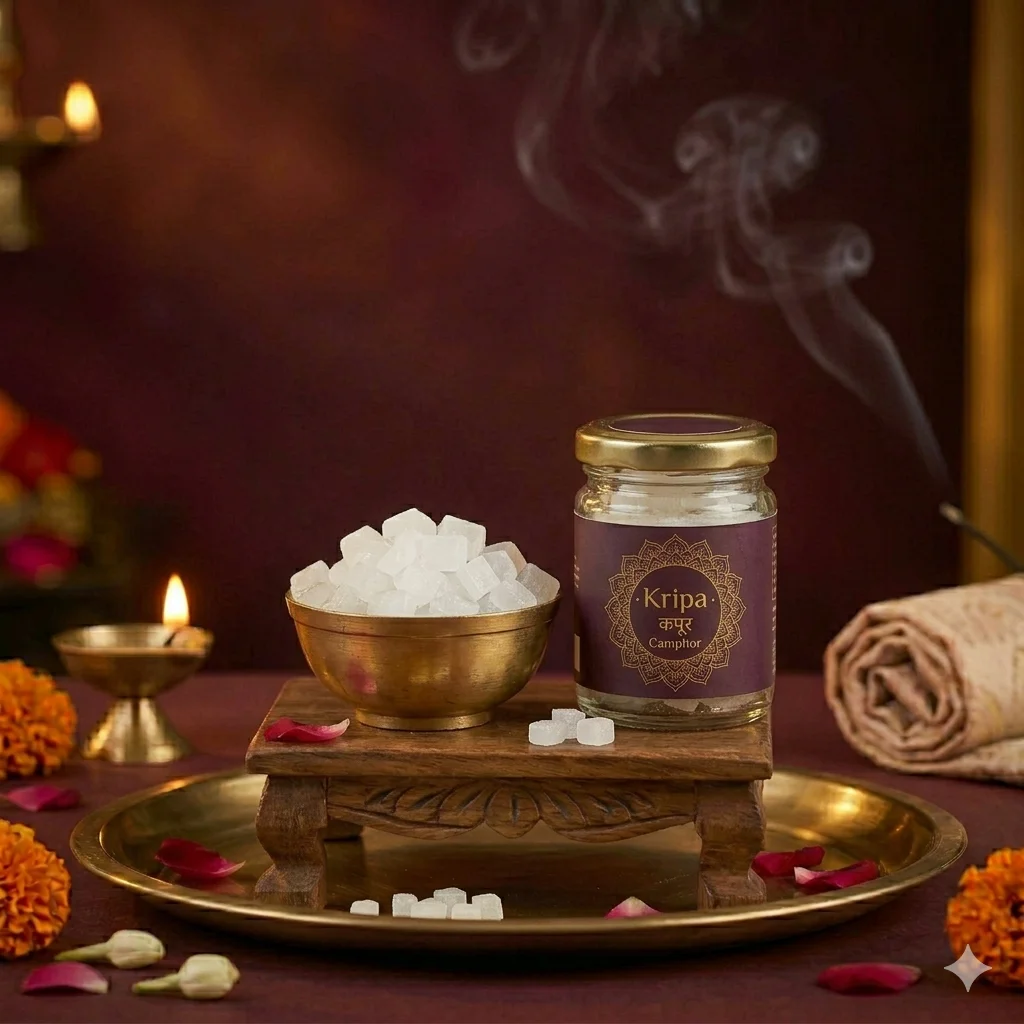
Real Bhimseni camphor — crystalline, bitter-fragrant, smokeless. The pure camphor of aarti and Vedic homa.
A simple, safe home havan
You do not need a priest to perform a small havan at home. Here is the most stripped-down version possible — a beginner can do it on a Sunday morning in fifteen minutes.
- Choose your kund. A small copper or brass havan kund (square or pyramidal) is ideal. Place it on a fire-safe tile, on the floor, in an open or well-ventilated room.
- Lay the base. Place a handful of dry mango wood (or any dry, untreated wood) at the bottom in a crisscross pattern.
- Ignite with camphor. Set one camphor tablet at the centre. Light it with a long match.
- First offering — ghee. Once the camphor catches the wood, drop a teaspoon of ghee in. The fire will brighten.
- Second offering — samagri. Take a pinch of samagri in your right hand. Chant the mantra of your choice (the simplest is "Om Swaha"). At Swaha, drop the samagri into the fire.
- Repeat 11, 21, or 108 times — whatever feels appropriate to your time and intention.
- Close. Offer one final spoonful of ghee. Sit in silence as the fire dies down. Do not extinguish it with water — let it complete its cycle naturally. Once cool, the ash is sacred (vibhuti) and traditionally applied to the forehead.
Safety
- Never leave a havan unattended.
- Keep a small bowl of water nearby, just in case.
- Open a window — havan smoke is meant to fill the room, but you want airflow.
- Do not perform havan under a low-hanging fan, near curtains, or directly under a smoke detector.
A monthly havan — perhaps on the new moon or full moon — is enough to feel its effect. The smell of the smoke lingers in the home for hours, and so does the quiet it creates.